The Riyadh Design Law Treaty, adopted by WIPO members, aims to streamline global industrial design protection, fostering innovation and inclusivity.
India’s participation underscores its commitment to empowering startups, SMEs, and designers through improved intellectual property frameworks and policies.
Riyadh Design Law Treaty (DLT) – Key Highlights
The Riyadh Design Law Treaty (DLT) is a landmark international agreement adopted by the member states of the World Intellectual Property Organization (WIPO).
It aims to harmonize and simplify procedural frameworks for industrial design protection across multiple jurisdictions.
The treaty standardizes requirements, reducing administrative burdens for applicants and promoting global design creativity.
Key Provisions:
Relaxed time limits for applications.
Reinstatement of lost rights and correction/addition of priority claims.
Simplified procedures for recording assignments and licenses.
Option to file multiple designs in a single application.
The DLT supports innovation and market growth by streamlining global design protection, empoweriIt encourages the implementation of electronic systems for design applications and the electronic exchange of priority documents among contracting parties.
The treaty particularly benefits small and medium-sized enterprises (SMEs), startups, and independent designers by making design registration processes ng creators, and fostering inclusive economic development worldwide.
India’s Role:
Over the past decade, design registrations in India have tripled, showcasing significant growth in the field.
Domestic filings for design registrations have increased by 120 percent in the last two years.
Design applications in India grew by 25 percent last year, reflecting strong policy impact.
Initiatives like Startup India and the Startups Intellectual Property Protection (SIPP) scheme empower startups and SMEs to secure global design rights.
Practice Question: Discuss the significance of the Riyadh Design Law Treaty in promoting global innovation and India’s role in fostering inclusive growth through design protection. (150 Words /10 marks)
2. National Commission for Scheduled Castes organizes Interaction Programme with NCST, NCM, NCBC and NCSK
The NCSC organized an interaction programme with NCST, NCM, NCBC, and NCSK to address common challenges and enhance their effectiveness.
The focus was on strengthening infrastructure, resolving legal hurdles, and ensuring speedy justice.
A joint memorandum will be submitted to the government for improving the Commissions’ functioning.
National Commission for Scheduled Castes (NCSC), National Commission for Scheduled Tribes (NCST), National Commission for Backward Classes (NCBC):
Constitutional provisions:
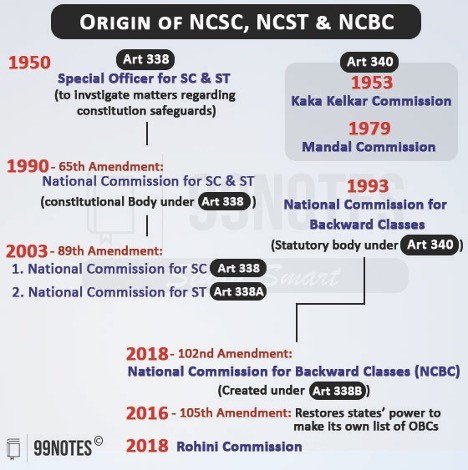
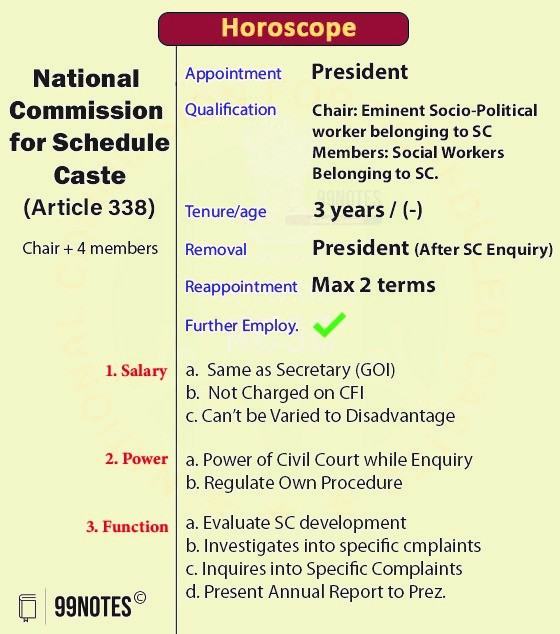
NCSC is established under Article 338 of the Indian Constitution, which empowers the Commission to safeguard the rights of Scheduled Castes.
NCST is established under Article 338A, which focuses on the welfare and protection of Scheduled Tribes.
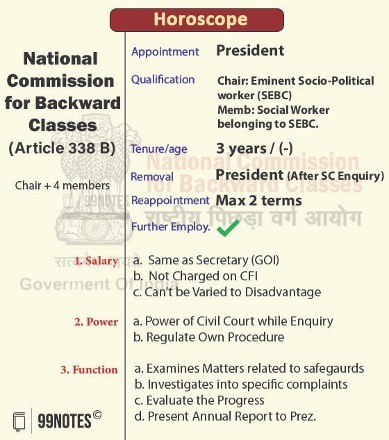
NCBC was established under Article 338B, following the 102nd Constitutional Amendment, to safeguard the interests of Backward Classes.
Mandate of NCSC, NCST, and NCBC:
Safeguard and promote the welfare and rights of Scheduled Castes (SCs), Scheduled Tribes (STs), and Backward Classes (OBCs).
Investigate grievances and address specific complaints related to the deprivation of rights and discrimination.
Monitor the implementation of constitutional and legal safeguards for these communities.
Advise the government on policies and schemes for the socio-economic development of SCs, STs, and OBCs.
Recommend measures to ensure effective participation in public services and socio-economic activities.
Prepare annual reports on the status of welfare and development of SCs, STs, and OBCs, and submit them to the President.
Ensure that affirmative action programs, such as reservations, are properly implemented.
National Commission for Minorities (NCM)
Constituted in 1992 under the National Commission for Minorities Act, 1992.
Focuses on the welfare and protection of religious and linguistic minorities.
Monitors the implementation of safeguards for minorities in laws and schemes.
Investigates complaints regarding deprivation of rights and safeguards of minorities.
Advises on socio-economic development measures for minorities and promotes harmony.
National Commission for Safai Karamcharis (NCSK)
Set up under the National Commission for Safai Karamcharis Act, 1993, later extended as a non-statutory body.
Monitors the implementation of laws related to the welfare of Safai Karamcharis and manual scavengers.
Inquires into complaints regarding deprivation of rights and harassment of Safai Karamcharis.
Recommends welfare measures, rehabilitation, and alternative livelihood opportunities.
Conducts awareness campaigns and submits annual reports to the government.
Challenges And Way Forward:
Issues with the Working of Commissions:
Lack of adequate infrastructure and facilities to carry out functions efficiently.
Legal challenges and court cases stalling recommendations and actions of the commissions.
Limited coordination and collaboration among the commissions to address common issues effectively.
Insufficient resources and manpower to address the increasing volume of grievances.
Slow pace of implementation of recommendations, affecting timely justice for marginalized communities.
Way Forward:
Strengthen infrastructure and increase budgetary allocations for the commissions.
Foster inter-commission cooperation and collaboration.
Streamline legal processes to ensure quicker resolution of issues.
Improve public awareness about the functions and roles of the commissions.
Regularly update and reform policies to meet the evolving needs of marginalized communities.
PYQ: Discuss the role of the National Commission for Backward Classes in the wake of its transformation from a statutory body to a constitutional body. (250 Words /15 marks) (UPSC CSE (M) GS-2 2022)
Practice Question: Examine the roles and challenges of national commissions like NCSC, NCST, NCM, NCBC, and NCSK in safeguarding the rights of marginalized communities. Suggest measures to enhance their effectiveness and coordination. (250 Words /15 marks)
Objectives of Monetary Policy The primary objective of monetary policy is to maintain price stability while keeping in mind the objective of growth. Various instruments of monetary policy, viz. cash reserve ratio (CRR) and statutory liquidity ratio (SLR) of banks, open market operations of the Central Bank, and imposition of credit ceilings, etc., are used…
PRESS INFORMATION BUREAU 3-June-2023 Daily Current Affairs For UPSC ,The PIB ( Press Information Bureau ) Facebook-f Twitter Youtube 1. Centre imposes stock limits on Tur and Urad dal. Topic: GS3 – Inflation, food security. Context: The Government of India has imposed stock limits on tur dal and urad dal to prevent hoarding and speculation…
Join 99Notes IAS Institute Get A Free Counseling By Our Professional UPSC Counsellors. Send message On Whatsapp UPSC Current Affairs Here You can also attempt questions carefully developed by our team on those topics, which have high likelihood of being asked in the future exams, alongside the NOTES. Get Connected With Us Email info@99Notes.in Let’s…
1. Privilege breach proceedings against MLAs can continue in next Assembly: Madras HC (Source – The Hindu, International Edition – Page No. – 2) Topic: GS2 – Indian Polity – Judiciary Context The Madras High Court ruled that breach of privilege proceedings against MLAs can continue even after the dissolution of the Assembly, emphasising the…
PRESS INFORMATION BUREAU 9-September -2023 Daily Current Affairs For UPSC ,The PIB ( Press Information Bureau ) Facebook-f Twitter Youtube 1) Special Campaign 2.0: Cleanliness campaign by Ministry of Mines The campaign was launched by the Secretary, Ministry of Mines on 22nd oct, 2022 at New Delhi. The Ministry identified 84 site offices throughout India…
PRESS INFORMATION BUREAU 5-January -2024 1. Ministry of Environment, Forest, and Climate Change submits proposals for Wetland City Accreditation under the Ramsar Convention on Wetlands for cities of Indore, Bhopal and Udaipur. Topic: GS3 – Environment – Conservation UPSC candidates should study Ramsar Convention, Wetland City Accreditation, and India’s conservation efforts for urban wetlands for environmental…